Commercial parking lot striping is critical to managing traffic, pedestrian safety, and protecting property owners’ liability. Features like parking space lines, directional arrows, crosswalks, and ADA markings help drivers move safely and businesses operate smoothly.
In this introduction to parking lot safety, we help business owners and property managers reduce confusion and minimize risk in high-traffic areas by outlining relevant parking lot striping standards. While specific requirements vary by jurisdiction, the baseline principles are consistent across all commercial properties in the U.S.
Table of Contents
Why Parking Lot Striping Standards Matter (Safety, Liability, Capacity)
Parking lot striping is in place to control vehicle and pedestrian traffic on and around commercial properties. Most jurisdictions must follow guidance from the Manual on Uniform Traffic Control Devices (MUTCD) for color conventions and marking practices. The Americans with Disabilities Act (ADA) establishes accessibility requirements.
When pavement markings fade or become inconsistent, problems follow:
- Drivers hesitate or create their own paths
- Pedestrian conflict points increase
- Fire lanes and loading zones become unclear
- ADA spaces fall out of compliance
Well-planned pavement line striping improves:
- Safety: Clear markings minimize the risk of collisions.
- Operational flow: Defined drive aisles prevent bottlenecks.
- Capacity: Efficient layouts maximize usable stalls.
- Compliance: ADA access aisles and fire lanes remain clearly designated.
Quick Visibility Checklist
- Are parking lines visible at night and during wet weather?
- Are crosswalks clearly marked?
- Are ADA stalls and access aisles correct?
- Are fire lanes and loading zones designated?
- Does the layout support one-way/ two-way traffic patterns?
Key Parking Lot Striping Standards Every Property Manager Should Know
While there are standards for commercial parking lot striping projects, site constraints and municipal codes ultimately control the final layout. Always verify local code.
Below are some of the most common parking lot striping layouts and dimensions:
Typical Line Width
- 4 inches is the most common width for parking lines.
- Some facilities use wider lines for better visibility or durability.
- Local standards may allow 4–6 inches.
Common Stall Size
- Standard parking spaces are often around 9 feet wide by 18 feet long.
- Dimensions vary by city and property type.
Two-Way Drive Aisles
- Many commercial lots use drive aisles around 24 feet wide to accommodate two-way traffic.
- Final width depends on turning needs and site design.

Parking Lot Striping Layout Basics (Traffic Flow Comes First)
An effective parking lot striping layout starts with traffic flow. Before striping, planners evaluate:
- Entrances and exits
- Primary travel lanes
- Sight lines and visibility
- Delivery and loading routes
One-Way vs Two-Way Aisles
- One-way aisles work well with angled parking.
- Two-way aisles are common with 90-degree parking.
- Angled layouts can improve flow in high-turnover retail settings.
Where Key Markings Go
- Directional arrows in main travel lanes
- Stop bars near exits
- Speed bump markings
- Crosswalks connecting parking fields to entrances
- Loading zones near delivery areas
Parking Space Dimensions and Line Specifications for Commercial Lots
Parking lot striping dimensions depend on property type, traffic volume, and local regulations.
Common Categories
- Standard stalls
- Compact stalls (if permitted locally)
- Oversized stalls (industrial or fleet use)
- Drive aisles
- Pedestrian walk zones
How Long Are Parking Lot Lines?
There is no universal length for parking lot lines. They typically run the length of the stall, so it depends on the stall’s layout. For example:
- If a stall is 18 feet deep, the side lines will run close to that length.
- Row edge lines may run continuously along the entire parking field.
Dimension Tips
- Standardize stall widths across each row for a cleaner install.
- Plan for end caps, cart corrals, and landscape islands.
- Account for turning radii at row ends to prevent tire overrun.
ADA Striping Requirements Every Commercial Lot Must Get Right
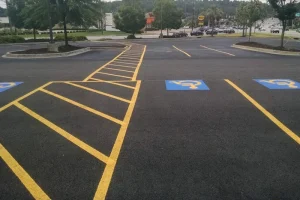
Accessibility is one of the most enforced design elements of parking lot marking. According to ADA parking requirements:
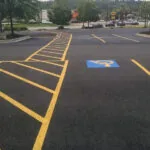
- A standard accessible space must be at least 96 inches (8 feet) wide.
- It must include an access aisle at least 60 inches (5 feet) wide.
Van-accessible options commonly include:
- 132-inch (11-foot) wide space + 60-inch aisle
OR - 96-inch (8-foot) wide space + 96-inch aisle
The access aisle must connect to an accessible route that does not require someone to travel behind parked vehicles.
ADA does not mandate a specific paint color. However, many jurisdictions use blue markings to highlight accessible parking. Always confirm local requirements.
Parking Lot Color Code: What White, Yellow, and Blue Typically Mean
The MUTCD recognizes several pavement marking colors, including white, yellow, red, blue, and purple. In most commercial parking lot striping projects:
- White marks parking stalls, lane lines, and directional arrows.
- Yellow marks caution areas, no-parking zones, and separation lines.
- Blue highlights accessible parking markings.
Fire lane colors and curb markings vary significantly by municipality. Always confirm local fire code and Authority Having Jurisdiction (AHJ) requirements.
Fire Lanes, Loading Zones, Crosswalks, and Safety Markings
Fire lanes must remain unobstructed and clearly identified. Local ordinances often specify stenciling and curb paint color. The National Fire Protection Association (NFPA) encourages fire apparatus access roads with layouts that feature:
- 20 feet minimum unobstructed width
- 13.5 feet vertical clearance
High-conflict areas deserve priority, including:
- Main entrances
- Primary crosswalks
- Loading docks
- Drive lane intersections
Materials and Methods (Paint vs Thermoplastic and Why It Matters)
When it comes to commercial parking lot striping in the Carolinas, the region’s climate and traffic patterns dictate material selection. Established parking lot paving companies know how to overcome these challenges and will choose materials best suited to your property’s needs.
Some of the material choices to choose from include:
Traffic-Grade Paint
- Cost-effective
- Suitable for standard parking fields
- Ideal for routine re-striping cycles
Thermoplastic
- More durable
- Performs well in high-wear zones
- Common in intersections and crosswalks
Carolina Asphalt adheres to professional parking lot striping standards, ensuring property owners and managers get the most from their investment in safety and accessibility. Before we begin, we thoroughly clean the surface, remove old lines, and dry the pavement. Once the area has been prepared, we install your new parking lot markings with precision.
How Often to Re-Stripe a Commercial Parking Lot
Traffic volume, climate, and pavement condition all play a role in determining how often parking lot striping should be refreshed. Common catalysts for re-striping include:
- Lines fading at night or during rain
- Customer complaints about unclear parking lines
- Recent sealcoating or surface repairs
- Near-miss incidents or traffic confusion
A proactive maintenance schedule protects parking lot safety and avoids compliance issues. Many commercial properties plan refresh cycles every 1–3 years, with touch-ups in high-wear areas such as entrances, crosswalks, and loading areas. The goal is to restripe before markings become “guesswork.”
Commercial Parking Lot Striping Checklist
Develop a structured plan before you begin your commercial parking lot striping project. The following checklist will keep your parking lot marking project organized and consistent:
- Confirm local code requirements and ADA stall counts
- Verify accessible routes, slopes, and drainage
- Map traffic flow and delivery routes
- Identify required safety markings (crosswalks, stop bars, speed markings)
- Choose materials (paint vs thermoplastic)
- Schedule your project during off-hours or on weekends to reduce business disruption
- Plan on conducting a final walkthrough before reopening
Parking Lot Striping in the Carolinas
Due to the region’s climate and traffic volumes, commercial parking lot striping projects in Charlotte, Raleigh, Greensboro, Winston-Salem, Columbia, and Greenville often prioritize high-visibility markings and routine touch-ups near entrances and crosswalks.
Some considerations to help extend the life of your parking lot striping:
- High UV exposure can fade parking space lines faster.
- Heavy rain events accelerate wear in drive lanes.
- Retail, medical, and industrial sites with constant turnover typically require more frequent touch-ups.
Ensure Your Parking Lot Meets Striping Standards With Professional Planning
Professionally installed parking lot lines enhance safety, ensure compliance, and improve traffic flow on and around your property. If your markings are fading or your layout needs evaluation, professional planning can help ensure your lot meets local parking lot striping standards and operational needs.
Contact Carolina Asphalt today to request a quote or layout evaluation and keep your property safe and organized.